“You open your phone for 5 minutes… and lose 30.” We’ve all been there. This same “time-trap” is now happening with AI. We start using a tool to save time, but we end up spending hours fixing its mistakes. Instead of the AI working for us, we end up working for the AI.
The numbers back this up. While Forbes says 64% of bosses think AI will make things faster, Gartner predicts that 85% of AI projects will actually fail by 2025. Even the 2024 Stanford AI Index points out that while AI is getting smarter, using it is getting more complicated.
So, why is there such a big gap between the “hype” and the “results”? Let’s look at the simple reasons.
According to a Gartner 2025 survey, only 22% of organizations that invested in AI have successfully deployed models beyond pilot stages. Similarly, a Deloitte 2024 “State of AI” report found that just 28% of companies say their AI initiatives have “significantly improved business outcomes.”
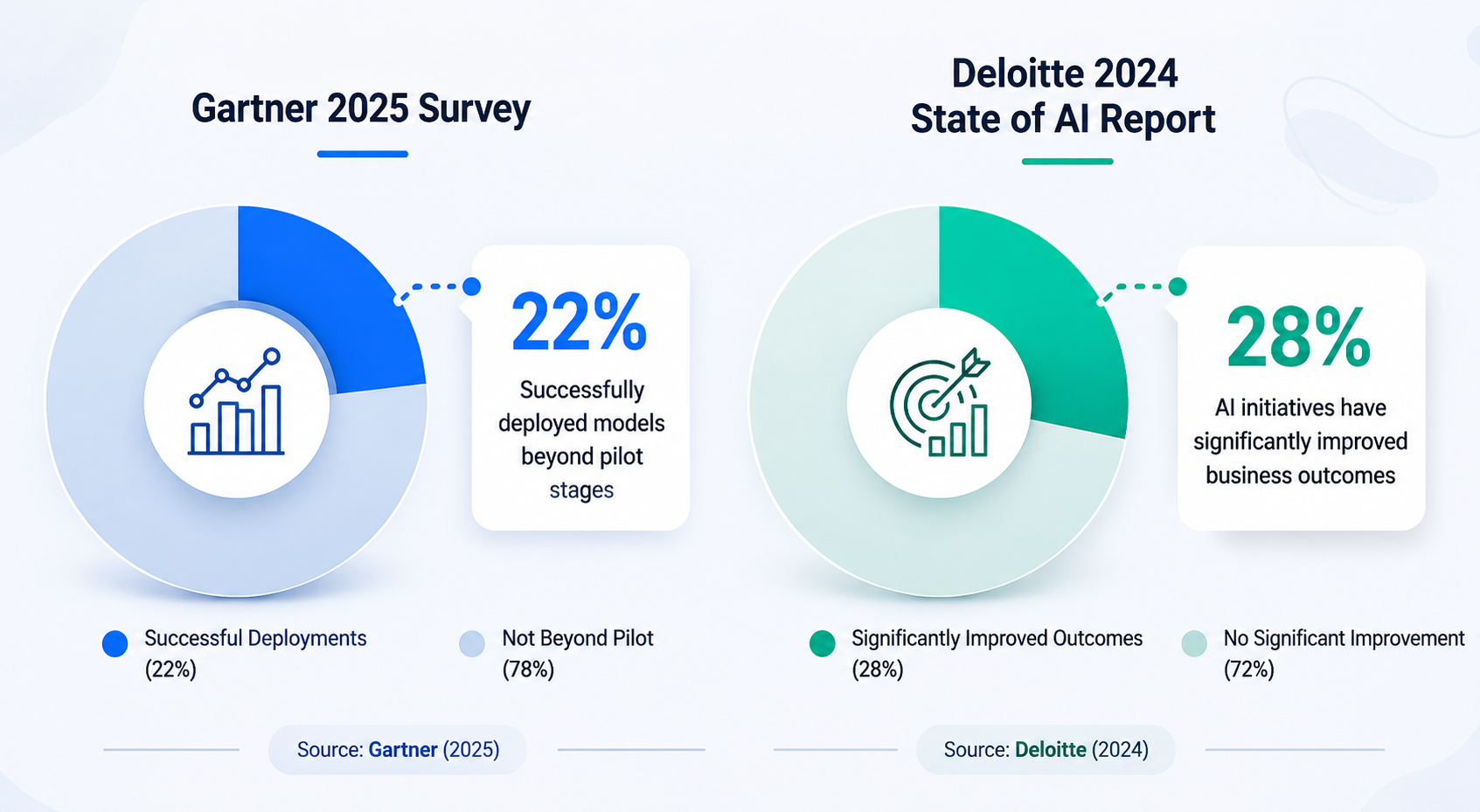
So what’s going wrong?
The truth: most AI projects collapse not because of poor models, but because of poor workflows, from messy data pipelines to unclear problem framing.
1. The “Vending Machine” Mistake
Most people treat AI like a vending machine: you press a button and expect a perfect snack. But AI doesn’t work that way. A massive report by MIT Sloan and BCG found that only 10% of companies are actually making money from AI.
The reason? They treat AI like an “intern,” not a machine. If you give an intern confusing instructions, you get a confusing result. Success with AI requires a clear plan, not just a “magic” prompt.
The Problem of “Data Debt”
Think of AI like a chef. If you give a world-class chef rotten ingredients, the food will taste terrible. This is “Data Debt.” A Salesforce study found that 67% of tech leaders are failing because their information is messy or old. If your data is “garbage,” the AI will just produce “garbage” faster.
2. Trying to Automate Everything
One big rule from our Editorial Guide is “Clarity over Complexity.” Many teams try to automate the entire job, and that’s where things break. You lose the “human touch” that readers and customers actually care about.
- The Wrong Way: “Which AI tool can do this whole job for me?”
- The Right Way: “Which specific part of my job is slowing me down?”
A Real Example: A marketing team used AI to write 100% of their articles. Their views dropped by 40% because the writing felt robotic. When they switched to using AI just for research and outlines (the “Rising Action”) but wrote the words themselves, their speed doubled and their quality stayed high.
3. The “Productivity Paradox”
In a good story, the “Climax” is where everything comes together. In an AI workflow, the climax is Human Verification. You cannot skip this part.
A study by Harvard Business School found that people using AI were 40% more productive at creative tasks. However, for “thinking” tasks, those same people were 19% more likely to make big mistakes because they trusted the AI too much.
The 2-4 Line Rule
In our writing guide, we say paragraphs should be 2-4 lines so they are easy to read. Use this same logic for AI. Don’t ask it to “do everything.” Break it down into small, simple steps. It’s much harder for the AI to mess up a small task than a huge one.
4. It’s a Habit Problem, Not a Tool Problem
As we often say: “The problem isn’t the tools; the problem is the habits.” You can’t put a rocket engine on a broken bicycle and expect it to fly. If your basic way of working is messy, AI will just make the mess bigger.
How to actually get results:
- Clean your data: Make sure your info is correct before you give it to the AI.
- Use the APP Method: Agree on the problem, Promise a result, and Preview the steps.
- Stay in the loop: Never let the AI have the “final say.” A human must always check the work.
How Top Brands Fixed Their AI
The difference between failure and success isn’t the tool, it’s how the workflow is built. When companies stop trying to “automate everything” and start fixing specific bottlenecks, the results are massive.
Airbnb: Slashing Launch Times by 60%
Airbnb realized their engineers were wasting too much time on the manual, technical steps of setting up AI models. To fix this, they built their own internal software to handle the “boring” technical parts automatically.
The Result: They finished their work 60% faster.
The Impact: Because it became so easy to use, twice as many teams across the company started building AI tools.
Moderna: Speeding Up Research by 80%
Moderna, the vaccine company, used AI to help scientists analyze complex data. Instead of making scientists learn coding, they gave them an AI assistant that spoke “science.”
The Result: They found that their teams could complete research tasks 80% faster.
The Key: They didn’t replace the scientists; they gave the scientists a “super-powered” assistant to handle the data crunching.
Conclusion
Whether you are writing a simple blog or running a big company, AI is just a tool. McKinsey says AI could add trillions to the economy, but only for those who keep the “Human-First” mindset.
If your AI isn’t making your life easier, you’re using it wrong. Simplify your steps, clean your data, and remember: you are the boss, the AI is the assistant. AI success is not about the fanciest model, it’s about system design.
Organizations that treat AI as a continuous ecosystem (collecting data → refining models → measuring results → retraining) outperform those chasing one-off experiments.
If you want your AI to deliver value, think less like a data scientist and more like a systems architect. Because the future of AI isn’t about algorithms, it’s about flow.