Introduction
Imagine waking up one day and realizing that a machine can do your job faster, cheaper, and without rest.
This is not a distant future. It is already happening.
Artificial intelligence is writing content, analyzing data, automating workflows, and assisting in decision-making. For students, professionals, and even older generations adapting to technology, this raises a serious question:
Will AI eventually replace humans completely?
The concern is understandable. Reports suggest that millions of jobs could be impacted by AI in the coming years. But the real issue is not the speed of AI development.
The real issue is how we understand human work.
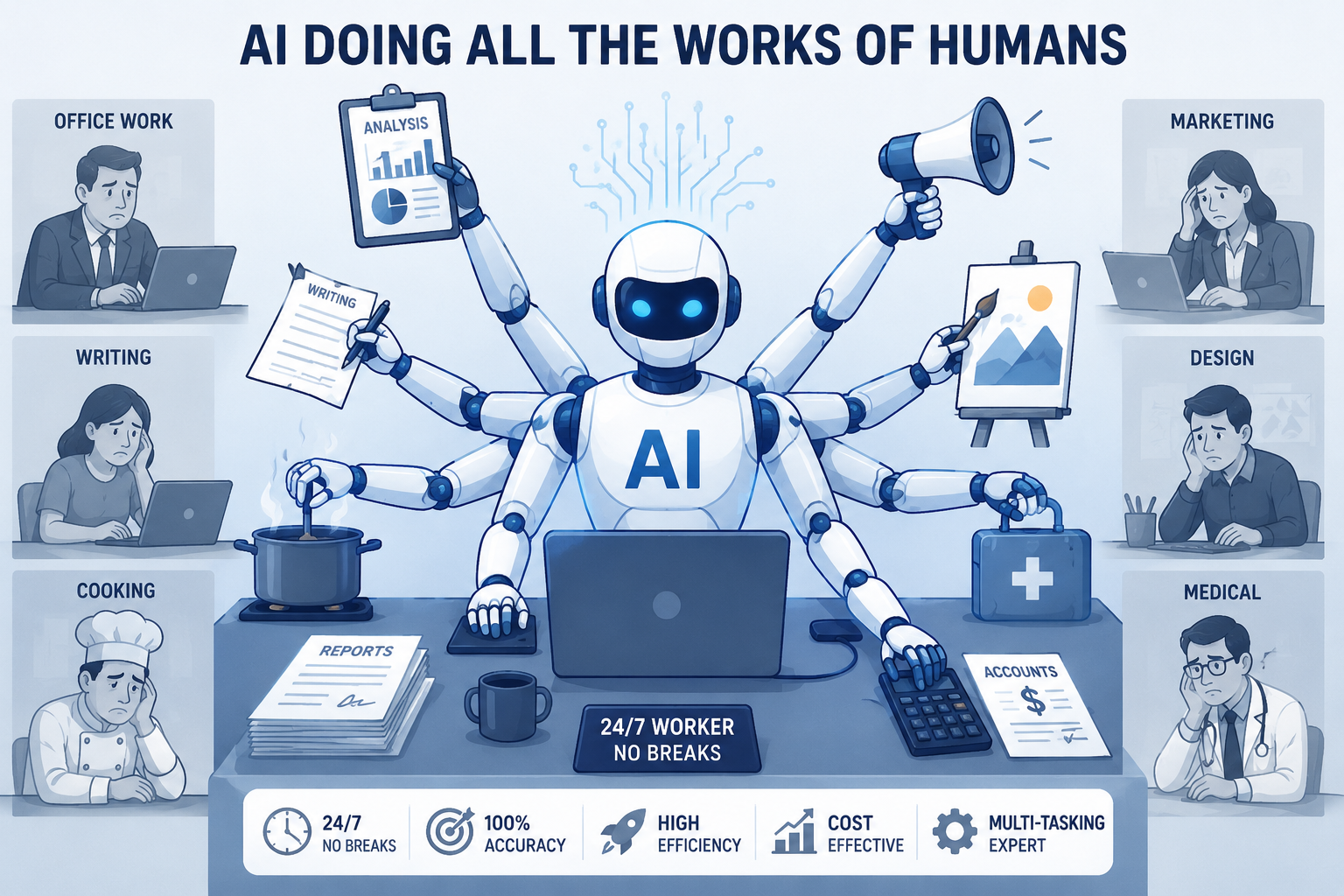
The Misconception About Replacement
The common belief is simple:
If AI can perform a task, the human performing that task becomes unnecessary.
This assumption is incomplete.
Jobs are not single tasks. They are a combination of multiple responsibilities, including:
- decision-making
- communication
- problem-solving
- handling uncertainty
AI can perform specific tasks efficiently. However, it cannot fully replace the broader role that humans play in real-world situations.
What AI Does Exceptionally Well
Artificial intelligence is highly effective in structured environments.
It performs best when:
- tasks are repetitive
- data is clearly defined
- patterns are consistent
This is why AI is already transforming areas such as:
- data processing
- customer support automation
- content generation
- workflow optimization
AI operates with speed and scale that humans cannot match. However, efficiency does not equal understanding.
Where AI Falls Short
Despite its capabilities, AI has clear limitations.
It does not:
- truly understand context in the human sense
- experience emotions or empathy
- make independent judgments in uncertain situations
- adapt naturally to unpredictable environments
Even advanced systems require human oversight. AI can generate outputs, but it cannot reliably evaluate their accuracy or relevance without human involvement.
The Human Advantage
Human capability goes beyond technical skill.
People bring elements that machines cannot replicate, including:
- emotional intelligence
- intuition
- lived experience
- ethical reasoning
These qualities are essential in roles that involve people, judgment, and complexity.
For example:
- a manager resolving team conflict
- a doctor making a critical decision
- a teacher understanding a student’s needs
These situations require interpretation, not just information.
Creativity and Original Thinking
AI can generate ideas based on existing data.
However, human creativity operates differently.
Humans create through:
- personal experience
- cultural understanding
- emotional depth
- imagination
AI recombines patterns. Humans originate meaning.
This is why human-created ideas often feel more relevant and impactful.
AI Still Depends on Humans
A critical reality often overlooked is that AI is not independent.
It requires human involvement at multiple levels:
- training the system
- providing accurate data
- verifying outputs
- correcting errors
AI systems can produce incorrect or misleading results, which makes human oversight essential.
In many cases, AI increases the need for skilled human involvement rather than eliminating it.
Work Is Changing, Not Disappearing
Technology has always reshaped work.
- industrial machines changed manual labor
- computers changed office work
- the internet changed communication
None of these eliminated human work. They transformed it.
AI is following the same pattern.
It is reducing repetitive tasks and shifting focus toward higher-value activities such as:
- critical thinking
- decision-making
- problem-solving
The Real Shift in Work
The most significant change is not job loss, but role transformation.
Work is moving from execution to direction.
This means:
- AI handles routine tasks
- humans guide, interpret, and decide
The value of human work is shifting toward thinking rather than doing.
What This Means for Individuals
This shift affects everyone:
- students preparing for future careers
- professionals adapting to new tools
- individuals navigating a digital world
The goal is not to compete with AI.
The goal is to use it effectively.
This requires focusing on:
- clear thinking
- adaptability
- problem-solving ability
- understanding how tools work
A Better Question to Ask
Instead of asking whether AI will replace humans, a more useful question is:
How will AI change what humans need to do?
This perspective leads to better preparation and more informed decisions.
Conclusion
Artificial intelligence will continue to evolve and improve.
It will automate tasks, increase efficiency, and reshape industries.
However, it will not replace humans completely.
Because human value is not limited to performing tasks.
It includes:
- understanding complex situations
- adapting to change
- making informed decisions
- working with people
These capabilities remain difficult to automate.
The future is not defined by competition between humans and AI.
It is defined by how effectively humans learn to use AI.